The Key to a forgotten region - localization for South America
Other
Table of content

Today you’re invited to cash your plane ticket. Hopp on, we’re going to the south. Our destination is a continent, home of more than 393 million people, living in 12 different countries. The most common languages spoken by the population are Portuguese and Spanish. Ready for takeoff? :)
We are pretty sure you already know where our journey through the world’s translation markets takes you today. Right, it’s South America. To dive deeper into the continent the regional translation market is analyzed to identify potentials in localization for South America.
With 37 language families and 448 languages spoken on the continent, South America is one of the most diverse areas around the globe concerning languages. There are 9 languages officially spoken consisting mainly of Indo-European languages imposed by the European colonization:
Aymara
Dutch
English
French
Guaraní
Papiamento
Portuguese
Quechua
Spanish
Alongside these Indo-European languages numerous indigenous languages are spoken. In some countries they are respected as co-official languages. Looking deeper at a specific region shall give you an overview of the diversity within indigenous languages. In Brazil 180 indigenous languages are spoken among various tribes.
When looking more closely at this impressive language diversity, differences between European Portuguese (pt-PT) and Brazilian Portuguese (pt-BR) stand out. Both are official languages in their particular country and differ in some points:
pt-PR and pt-BR are marked by a different pronunciation. The sound and melody of Brazilian Portuguese is considered to be softer and smoother.
There are some slight differences in grammar as well. The word order varies and Brazilians tend to replace the imperative by the indicative mode in common speech.
The two versions of Portuguese also differ in vocabulary and spelling:
Portuguese (Portugal) | Portuguese (Brazil) | English |
Vocabulary | ||
Olá! | Oi! | Hi! |
o cão | o cachorro | dog |
Spelling | ||
porquê? | por quê? | Why? |
o génio | o gênio | genius |
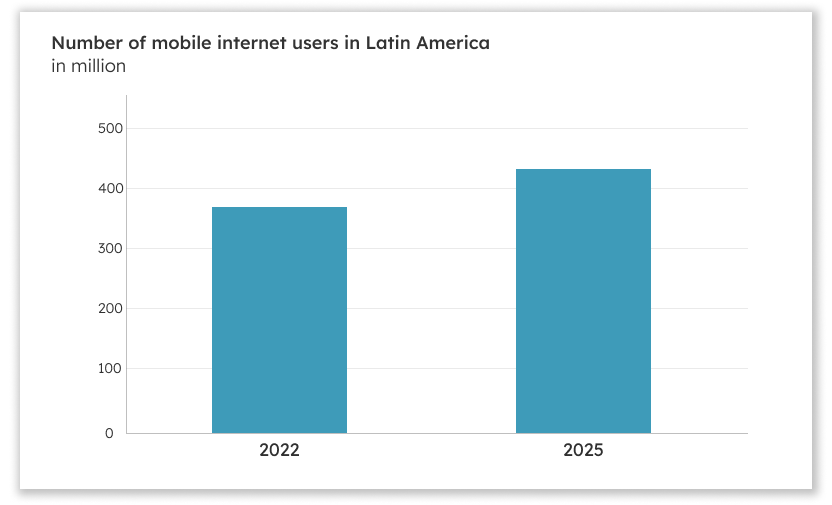
By diving deeper into the mobile market even more potentials in localization for South America can be discovered. In terms of mobile adoption and hiring of mobile services Latin America has been a region dominated by a strong growth over the past years:
By diving deeper into the mobile market, even more potential in localization for South America can be discovered. In terms of mobile adoption and hiring of mobile services, Latin America has been a region dominated by strong growth over the past years:
Average internet penetration in Latin America is around 68% and can increase to 75% in some countries.
The estimated value of Latin America retail sales via smartphones in 2021 is $64 billion, a 35% increase from the previous year.
In South America, Brazil has 32.5% of retail mobile e-commerce sales.
Mobile e-commerce represented about 47% of all e-commerce in Brazil.
Making up 8% of the world’s population, South America accounts for 10% of the global mobile market!
With 80.6% of internet penetration, it represents 6.8% of worldwide internet users.
In the past South America has been overtaken by Asia and and almost forgotten by the United States and Europe.
Sucked halfway down the road to economic development in the past, South America has been “the forgotten country” according to Multilingual. All this stats and figures dominated by growth point out enormous potentials in localization for South America. The huge growth rates adumbrate that the end hasn’t been reached yet and show that the region can’t be forgotten again. Localization is the key to open “the door to South America”.
The dollar sign ($) frequently used to refer to the U.S. dollar is used in Latin America to point out local currency. There’s another difference in the way money is written. In the U.S. $1,000.00 is the common spelling, while in Latin American Spanish $ 1.000,00 is used.
Also discover other regions we’ve already analyzed on our “journey around the globe”. The U.S., Europe and Asia are waiting to be discovered by you! :)

Market Spotlight: Do you have what it takes to make it in Brazil?
Brazil is a promising region to localize your product. The LingoHub team has conducted a thorough overview of the country and provided tips and best practices for adapting your business to its cultural and language nuances
Market spotlight: join the race for India's app market
With over a billion people and more than a thousand languages, India boasts a strong economy. Despite this, India is often overlooked as an emerging market. Learn about the importance of localization in India in our article.

Market spotlight: crash course on China's app ecosystem
Looking to expand your app's reach in China? Learn more about China app market from this article and let LingoHub - a reliable translation service help you

Market spotlight: 10 big players of India’s app market to keep your eye on
Let us introduce you to the major players in India’s current app market. We overviewed in this article the whole market and applications that are at the top.